
Ever since we launched call transcription for free to all our customers back at the beginning of 2023, one of the most requested features was expanding our support to cover additional languages.
We took the first step in this journey last year increasing our coverage from the 1.5 billion people who can speak English, to cover over 3 billion people by adding over 20 new languages including some of the most widely spoken languages such as Spanish, French and Portuguese.
South Africa is home to one of the most linguistically diverse cultures in the world – with eleven official spoken languages. While English is the language of business, the majority of South Africans mother tongue at home isn’t English.
QContact has invested significantly time and resources building on our existing world leading speech recognition powered by NVIDIA to deliver specific improvements for South Africa.
We are proud to announce we now support all eleven spoken languages of South Africa – English, isiZulu, isiXhosa, Afrikaans, Sepedi, Setswana, Xitsonga, siSwati, Tshivenda and isiNdebele. What’s more, we’ve tuned our existing world class English model on South African accents to further improve on our industry leading English accuracy.
Single letter mistakes
One of the challenges of the vernacular languages of South Africa is the complex grammar and compounding of words that aren’t as prevalent in European languages. Measures such as Word Error Rate (WER) while great for languages like English, don’t necessarily accurately reflect transcription accuracy in Bantu languages or Afrikaans.
Let’s take an example – in Xitsonga, imagine a transcription
Actual: ndziyavulavula
Heard: ndziyavulavla
To any Tsonga speaker they’d understand exactly what the word means (I am speaking), but it is one letter short, meaning 100% WER failure, when it is only a single letter wrong.
Or take another example – to say “I am being helped” in English you’d use four words, in Sesotho you use a single compound word of keabetswa. So now again imagine your transcription was one letter off, and heard “keabetswe” with an e rather than an a. In English your WER would be 25% for a single letter error, but in Sesotho you’re at 100% WER just for a single letter difference.
Compounds
For another example of why transcribing these languages can be so hard, let’s look at compound words. We have these in English – for example a word like checkout – is it “check out”, “check-out” or “checkout” – while all have identical meaning, choosing the wrong one would lead to 100% WER and yet to a human, they are identical.
And one language that loves to compound words is Afrikaans. Let’s translate “customer service call centre scheduling problem” to Afrikaans – klantediensoproepsentrumskeduleringsprobleem. Yep, that’s a single word in Afrikaans that won’t appear in any dictionary but is both spelt correctly and grammatically correct. So, while a single letter in English would mean 16% WER, a single letter wrong in that word would lead to 100% WER for the phrase.
Accuracy
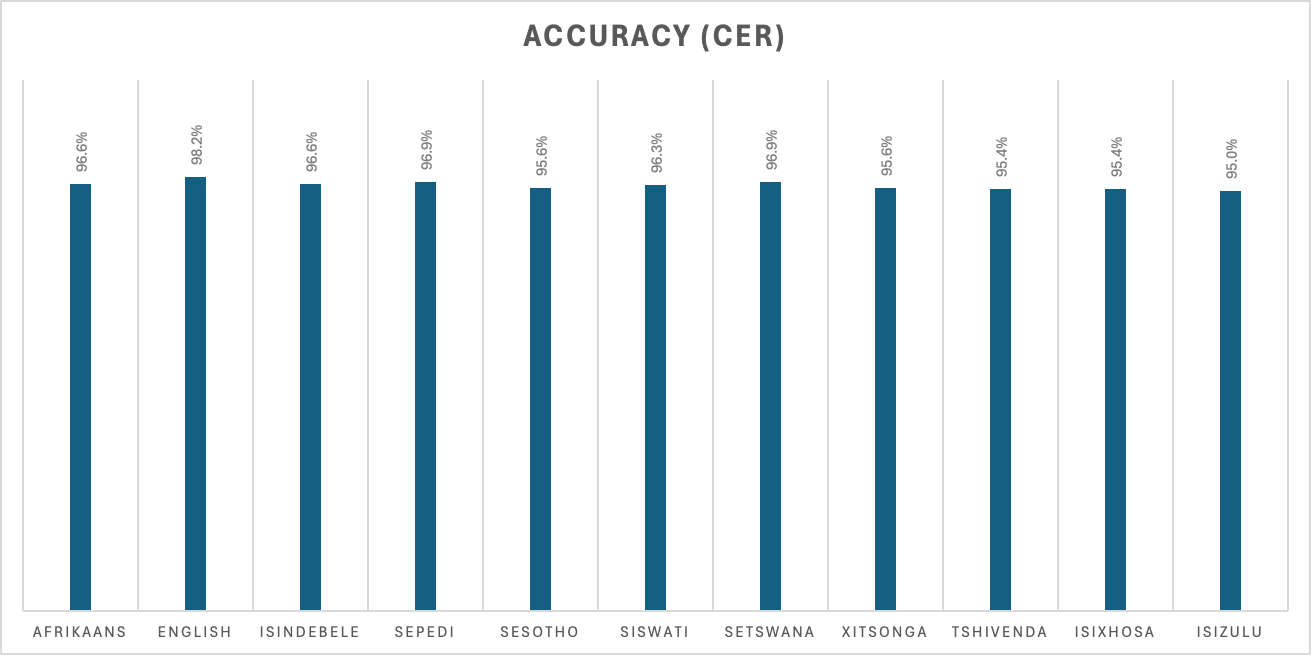
You can start to see why WER isn’t the best measure of accuracy in these languages. The industry generally measures these languages not in WER but Character Error Rate (CER). Let’s look at our accuracy on these languages
Code Switching
When you have bilingual speakers, people will often switch languages as they’re talking. Whether it’s Spanglish, Afriglish, Tsotsitaal or Iscamtho – people will mix words and sentences between languages. QContact has built dedicated South African and European models which allow switching to any of our supported languages throughout the call.
In summary
QContact now covers over 3 billion speakers in over 100 countries, across over 30 different languages, including all 24 official languages of the European Union, and all 11 official languages of South Africa. Transcription, AI summaries and conversation analytics across all these languages is included at no additional cost to all our customers.
So if you want to start understanding what your customers are saying in their language of choice, why not schedule a demo of QContact today!
Coverage
And if we compare our support for languages with some market leading solutions
European Languages
| Language | Speakers | Azure | Amazon | QContact | |
| English | 1450m | ✅ | ✅ | ✅ | ✅ |
| French | 320m | ✅ | ✅ | ✅ | ✅ |
| German | 135m | ✅ | ✅ | ✅ | ✅ |
| Italian | 68m | ✅ | ✅ | ✅ | ✅ |
| Spanish | 560m | ✅ | ✅ | ✅ | ✅ |
| Polish | 45m | ✅ | ✅ | ✅ | ✅ |
| Portuguese | 260m | ✅ | ✅ | ✅ | ✅ |
| Romanian | 30m | ✅ | ✅ | ✅ | ✅ |
| Dutch | 25m | ✅ | ✅ | ✅ | ✅ |
| Greek | 13m | ✅ | ✅ | ✅ | ✅ |
| Czech | 11m | ✅ | ✅ | ✅ | ✅ |
| Swedish | 10m | ✅ | ✅ | ✅ | ✅ |
| Hungarian | 13m | ✅ | ✅ | ✅ | ✅ |
| Bulgarian | 9m | ✅ | ✅ | ✅ | ✅ |
| Danish | 6m | ✅ | ✅ | ✅ | ✅ |
| Slovak | 5m | ✅ | ✅ | ✅ | ✅ |
| Finnish | 5.5m | ✅ | ✅ | ✅ | ✅ |
| Croatian | 5.5m | ✅ | ✅ | ✅ | ✅ |
| Lithuanian | 3m | ✅ | ✅ | ✅ | ✅ |
| Slovenian | 2.5m | ✅ | ✅ | ✅ | ✅ |
| Latvian | 1.9m | ✅ | ✅ | ✅ | ✅ |
| Estonian | 1.3m | ✅ | ✅ | ✅ | ✅ |
| Maltese | 0.5m | ✅ | ✅ | ✅ | ✅ |
| Total Coverage | 100% | 100% | 100% | 100% | |
South African Languages
| Language | Mother Tongue | Azure | Amazon | Callbi | Lelapa | Botlhale | QContact | |
| Afrikaans | 6.9m | ✅ | ✅ | ✅ | ✅ | ✅ | ✅ | ✅ |
| English | 5.1m | ✅ | ✅ | ✅ | ✅ | ✅ | ✅ | ✅ |
| isiNdebele | 1.1m | ✅ | ✅ | |||||
| Sepedi | 4.6m | ✅ | ✅ | ✅ | ||||
| Sesotho | 3.9m | ✅ | ✅ | ✅ | ✅ | |||
| siSwati | 1.3m | ✅ | ✅ | |||||
| Setswana | 4.1m | ✅ | ✅ | ✅ | ||||
| Xitsonga | 2.3m | ✅ | ✅ | |||||
| Tshivenda | 1.3m | ✅ | ✅ | |||||
| isiXhosa | 8.2m | ✅ | ✅ | ✅ | ||||
| isiZulu | 12m | ✅ | ✅ | ✅ | ✅ | ✅ | ✅ | ✅ |
| Mother Tongue Coverage | 47% | 72% | 47% | 63% | 59% | 100% | 100% | |
Learn more by downloading our white paper ASR Whitepaper 2026.1.2